Home → Past simple vs past continuous
Past simple vs past continuous
These two are not rivals — they do different jobs in the same sentence. The continuous paints the background; the simple is what happens against it.
The decision, in a table
| Past simple | Past continuous | |
|---|---|---|
| Shows | a completed action | an action in progress |
| Form | second form — read | was/were + -ing — was reading |
| Role in a story | the event | the background |
| Goes with | then, suddenly, at six o'clock | while, as, all morning |
| Irregular forms? | yes, 175 of them | never — every verb takes -ing the same way |
The interruption pattern
Nine times out of ten these two appear together, and the shape is always the same: something was going on, and something else cut across it.
- I was reading when the phone rang.
- While we were waiting, it started to rain.
- She was driving home when she saw the fire.
The long action takes the continuous, the short one takes the simple. Swap them and the sentence still parses but means something odd: I read when the phone was ringing says you sat down with a book because the phone was ringing.
Verbs that refuse the continuous
This is the part rules usually leave out. State verbs describe conditions, not activities, and conditions cannot be in progress.
- ✗ I was knowing the answer. ✓ I knew the answer.
- ✗ She was wanting to leave. ✓ She wanted to leave.
- ✗ They were owning a shop. ✓ They owned a shop.
The usual suspects: know, believe, understand, want, need, own, belong, seem, hate, prefer. Several of them — know, understand, mean — are irregular, so their past simple is the only past form you will ever need for them.
Good news about the forms
The past continuous needs no memorising at all. Was or were plus -ing, and the -ing form is perfectly regular for every verb in English, irregular ones included: going, taking, writing. All the difficulty in past tenses sits in the past simple and the participle.
Where the difficulty actually is
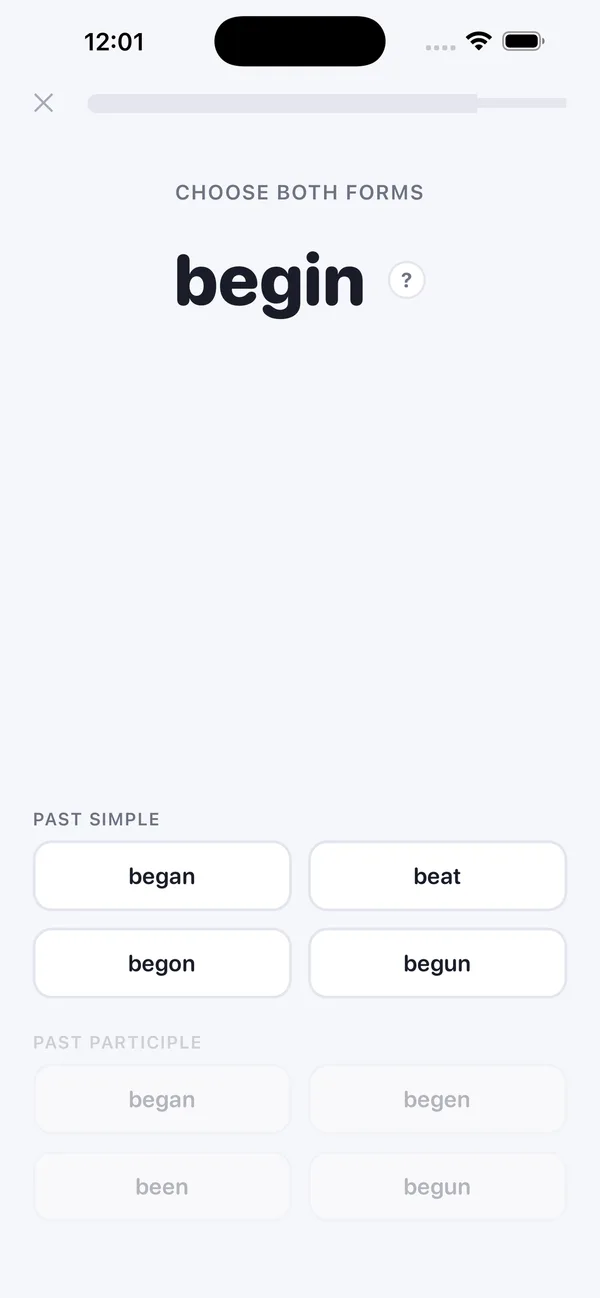
Practise all 175 verbs on your phone
Spaced repetition brings each verb back right before you would forget it. Three difficulty modes, a 60-second Blitz, streaks and a verb collection. Free, works offline, no account.