Home → How this list was made
How this list was made
Anyone can publish a table of irregular verbs — the three forms are public facts and every dictionary has them. What takes work is deciding which 175 verbs matter, in what order, and what is worth saying about each one. That work is described here so you can judge it.
Choosing the 175
English has several hundred irregular verbs if you count every archaic survivor. Most lists either stop at 50 and leave gaps, or run to 600 and bury the useful ones. We built the list the other way round: starting from the verbs a learner meets in their first months and working outwards until adding another verb stopped changing anything.
That produced three levels. Core is 53 verbs you cannot get through a day of English without. Intermediate is 65 more that turn up in conversation, news and exams. Advanced is 57 you will meet in reading rather than speech. Verbs like beseech and smite are included for completeness and openly marked as things that can wait.
Ordering by frequency, not alphabet
Every verb carries a frequency rank, and the list is sorted by it everywhere on this site. This is the single most useful thing we do with the data: alphabetical order puts abide before be, which is precisely the wrong thing to learn first.
The rank is our own editorial judgement, informed by how often each verb occurs in ordinary English rather than by a single corpus figure — a verb that is common in writing but rare in speech is ranked for the learner, not for the statistic. Where you see “number 5 of 175” on a page, that is this ranking.
Classifying the patterns
Irregular verbs are not random. They fall into 8 shapes inherited from older English, and we classify every verb into one of them by rule rather than by hand, so the classification is consistent and reproducible: the same verb always lands in the same group, and the rule can be checked against any verb you like.
The two largest groups are split again by how the third form is actually built, because a group of 73 verbs explained in one paragraph is not an explanation.
What we refuse to call a mistake
Each verb page names the errors learners make with that verb, and this is where a generated site can do real damage. It is easy to produce “hanged is wrong” automatically — and wrong, because people are hanged while pictures are hung.
So forms have to clear a check before a page calls them mistakes. Costed is right for a project, strived and weaved are accepted alternatives, putted belongs to golf, ringed and singed are ordinary words. Eighteen verbs are exempted for reasons like these. We would rather say nothing about a verb than teach something false about it.
Which verbs get their own page
Not all of them, deliberately. 32 of the 175 are rare enough that a separate page would mostly repeat the pattern explanation it belongs to, so what is worth saying about them is said on the pattern pages instead. Every verb is still covered in full — the difference is whether it justifies a page of its own.
Corrections
English changes and reference material goes stale. If a form, definition or example looks wrong, tell us. Corrections go into the verb data the app is built from, so a fix reaches the app and this site together and the two can never disagree.
What this site does not do
- No content copied or scraped from other sites. The verb data, definitions and example sentences were written for this project.
- No advertising, no affiliate links, no sponsored placements.
- No tracking, no cookies, no analytics script — see the privacy policy.
It is made and maintained by Grigory Frolov, alongside the app the data comes from.
Practise all 175 verbs on your phone
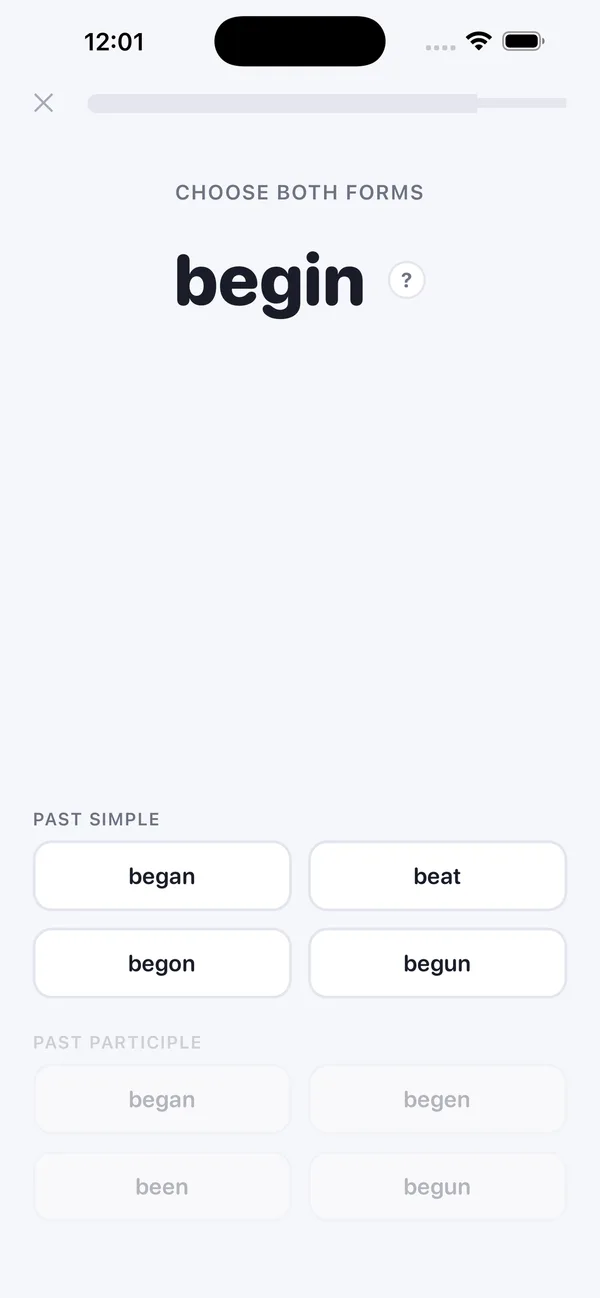
Spaced repetition brings each verb back right before you would forget it. Three difficulty modes, a 60-second Blitz, streaks and a verb collection. Free, works offline, no account.