Home → Regular and irregular verbs
Regular and irregular verbs
One group follows a rule you can learn in a minute. The other has to be memorised verb by verb. Knowing which is which is most of the battle.
The difference in one table
| Regular | Irregular | |
|---|---|---|
| Past simple | base + -ed | anything at all |
| Past participle | the same -ed form | often a third, different word |
| Example | work · worked · worked | go · went · gone |
| How many | thousands | about 175 in daily use |
| How to learn | one rule | one verb at a time |
How to tell them apart
You cannot. Nothing in the spelling of a verb announces which group it belongs to — work and walk are regular, wake and wear are not, and they look like siblings. There is no rule to apply and no ending to watch for.
What saves you is the size of the problem. Irregular verbs are a closed list: no new ones are being created, and English has been quietly shrinking it for a thousand years. Learn the list and the question never comes up again — everything not on it takes -ed.
The -ed rule, spelled out
For the regular half, only the spelling can trip you up:
- Most verbs: add -ed — walk → walked
- Already ends in -e: add -d — hope → hoped
- Consonant + y: -y becomes -ied — study → studied
- One vowel, one final consonant, stressed: double it — plan → planned
The pronunciation shifts too, and nobody teaches it: -ed is said as t after voiceless sounds (worked), as d after voiced ones (played), and as a full syllable only after t or d (wanted, needed).
Why irregular verbs exist at all
They are the older system. Before English settled on -ed, verbs marked the past by changing their vowel — the pattern still visible in sing · sang · sung and drink · drank · drunk. When the -ed ending spread, it swallowed the rare verbs first, because a verb nobody says often is a verb nobody remembers the odd form of.
The survivors are precisely the verbs used constantly: be, have, go, take, see. Their strangeness is a side effect of their usefulness, and it is why the irregular list is so front-loaded — the ten hardest verbs are also the ten you need most.
Which irregular verbs to learn first
In frequency order, because that is the order you will meet them:
| Base | Past simple | Past participle |
|---|---|---|
| be | was | been |
| have | had | had |
| do | did | done |
| say | said | said |
| go | went | gone |
| get | got | got |
| make | made | made |
| know | knew | known |
| think | thought | thought |
| take | took | taken |
| see | saw | seen |
| come | came | come |
After the first fifty the returns drop sharply. Verbs like beseech and smite are on the list for completeness, not because you will need them this year.
The full list of 175 → · How the past simple works →
Test yourself
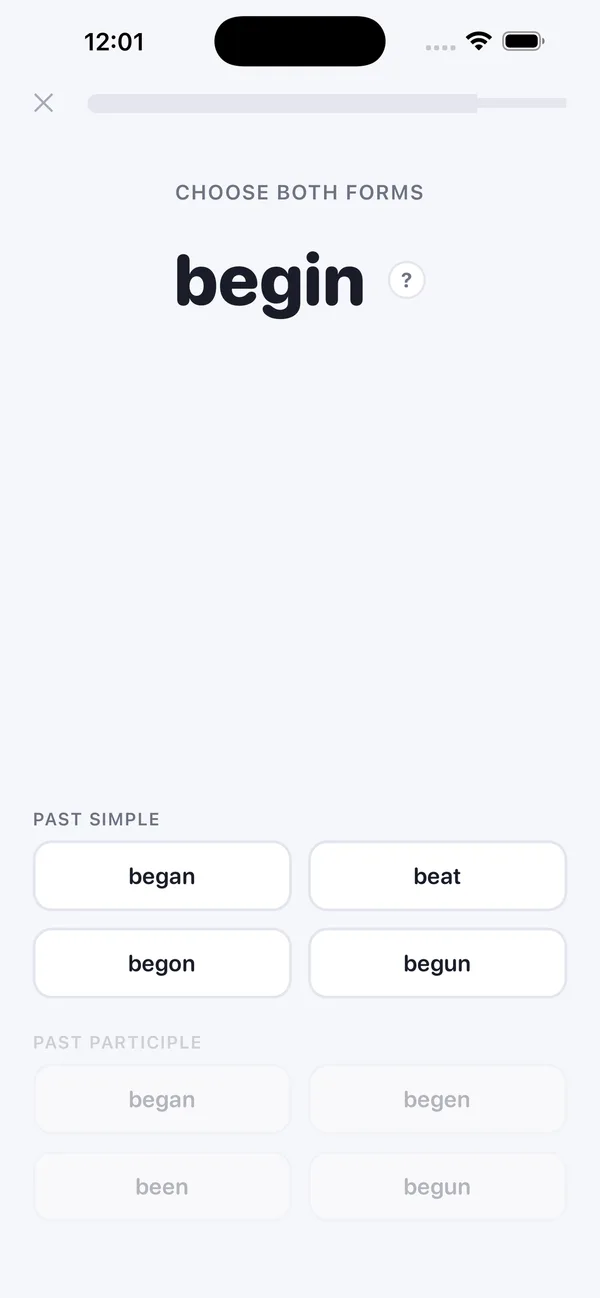
Practise all 175 verbs on your phone
Spaced repetition brings each verb back right before you would forget it. Three difficulty modes, a 60-second Blitz, streaks and a verb collection. Free, works offline, no account.