Home → Past simple
Past simple
The tense for things that are over. Something happened, it finished, and you can say when — I saw her yesterday. That last part is what separates it from every other past tense in English.
How to form it
Regular verbs add -ed, and the ending never changes for person: I worked, she worked, they worked. English drops the whole idea of agreement in the past, which makes this the easiest tense in the language to conjugate — and one of the hardest to spell.
| If the verb… | Then… | Example |
|---|---|---|
| ends in -e | add -d | live → lived |
| ends in consonant + -y | -y becomes -ied | carry → carried |
| ends in vowel + -y | just add -ed | play → played |
| ends in one vowel + one consonant, stressed | double the consonant | stop → stopped |
| is irregular | changes shape entirely | go → went |
That last row is the reason this site exists. Irregular verbs ignore -ed completely, and there are about 175 of them in daily use.
Negatives and questions: the mistake everybody makes
Once did enters the sentence, the main verb goes back to its base form. Did is already carrying the past tense, and English refuses to mark it twice.
- ✓ I went to the shop. ✗ I did go to the shop.
- ✓ I did not go. ✗ I did not went.
- ✓ Did you see it? ✗ Did you saw it?
If you fix nothing else about your past simple, fix this. It is the error that follows learners furthest into advanced English, precisely because the irregular form feels so hard-won that giving it up after did feels wrong.
When to use it
Use the past simple when the time is finished — and it counts as finished even if you do not say it out loud, as long as both of you know which time you mean.
- A finished moment: She left at six.
- A finished period: We lived in Perth for three years.
- A sequence of events: He woke up, made coffee and read the news.
- A past habit: I walked to school every day.
The usual signposts are yesterday, last week, in 2019, two hours ago, when I was a child. If one of those fits the sentence, the past simple is almost certainly the tense you want.
Past simple or present perfect?
This is where the past simple is actually decided. The present perfect ties the past to now and therefore cannot take a finished time: I have seen that film is fine, I have seen that film yesterday is not. Add yesterday and the sentence has to switch: I saw that film yesterday.
- Past simple — when it happened matters: I broke my arm in March.
- Present perfect — the result matters: I have broken my arm. (it is still in plaster)
The present perfect needs the third form, not the past simple — have broken, never have broke. Which is why the past participle is worth its own page, and why the choice between these two tenses gets a page of its own too.
The irregular verbs you will meet first
Ordered by how often they actually occur, so the ones at the top earn their place.
| Base | Past simple | Past participle |
|---|---|---|
| be | was | been |
| have | had | had |
| do | did | done |
| say | said | said |
| go | went | gone |
| get | got | got |
| make | made | made |
| know | knew | known |
| think | thought | thought |
| take | took | taken |
| see | saw | seen |
| come | came | come |
| give | gave | given |
| find | found | found |
| tell | told | told |
| become | became | become |
| leave | left | left |
| feel | felt | felt |
| put | put | put |
| bring | brought | brought |
| begin | began | begun |
| keep | kept | kept |
| write | wrote | written |
| run | ran | run |
| eat | ate | eaten |
| speak | spoke | spoken |
| drink | drank | drunk |
| read | read | read |
| buy | bought | bought |
| break | broke | broken |
All 175 irregular verbs → · How to tell regular from irregular →
Try it yourself
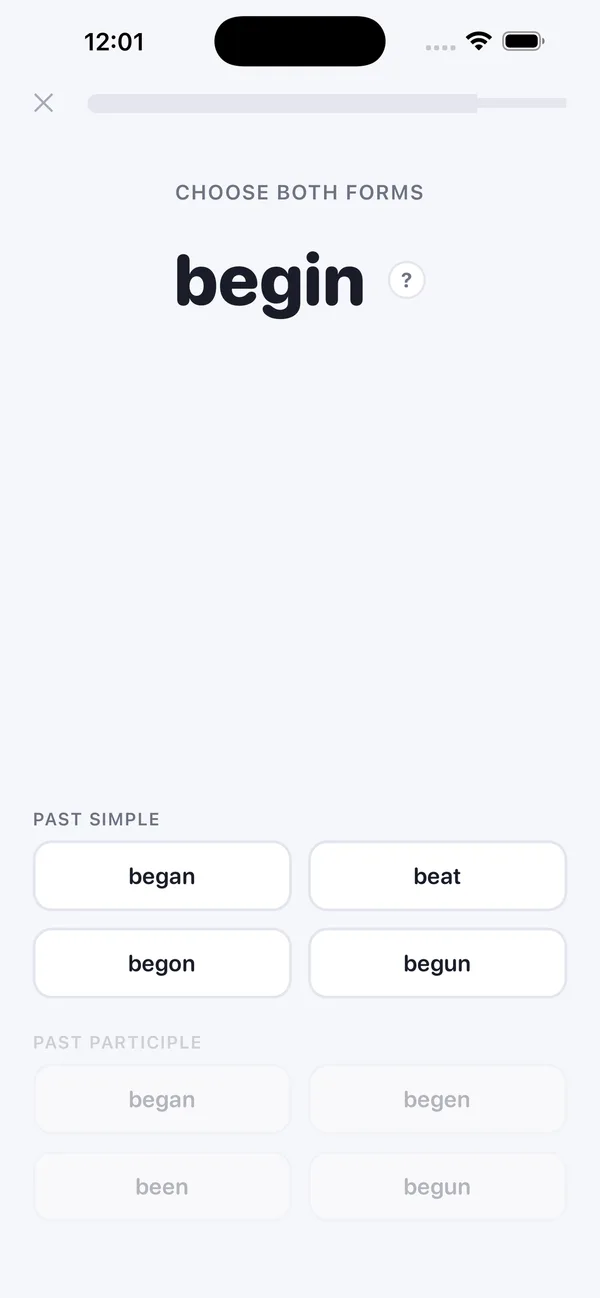
Practise all 175 verbs on your phone
Spaced repetition brings each verb back right before you would forget it. Three difficulty modes, a 60-second Blitz, streaks and a verb collection. Free, works offline, no account.