Home → Verb forms V1 V2 V3
Verb forms: V1, V2, V3
Shorthand for the three principal parts of an English verb. The numbering comes from textbooks used across India, the Middle East and much of Asia — English grammars written in Britain call the same three forms base, past simple and past participle.
When each form is used
- V1 — the dictionary form, and what follows to, did, will and can: I go to work by train. Did you go?
- V2 — the past simple, standing alone: I went to work by train.
- V3 — after have/has/had and in the passive: I have gone to work by train. It was done yesterday.
The trap is V1 after did. Did you went is wrong because did already carries the past — the main verb has to fall back to V1.
What about V4 and V5?
Some tables run to five. They are worth about a minute of your time, because unlike V2 and V3 they follow a rule with no exceptions at all:
| Form | What it is | Example |
|---|---|---|
| V4 | the -ing form | going, taking, running |
| V5 | the third-person -s form | goes, takes, runs |
Every English verb builds V4 and V5 the same way, irregular or not. All the difficulty lives in V2 and V3 — which is why this site is built around those two.
Regular verbs: V2 and V3 are the same
Work · worked · worked. For a regular verb, V2 and V3 are the identical -ed form, so there are really only two words to know. Irregular verbs are the ones where V2 and V3 can part company, and about 175 of them matter in everyday English.
V1 V2 V3 of the most common irregular verbs
| V1 | V2 | V3 |
|---|---|---|
| be | was | been |
| have | had | had |
| do | did | done |
| say | said | said |
| go | went | gone |
| get | got | got |
| make | made | made |
| know | knew | known |
| think | thought | thought |
| take | took | taken |
| see | saw | seen |
| come | came | come |
| give | gave | given |
| find | found | found |
| tell | told | told |
| become | became | become |
| leave | left | left |
| feel | felt | felt |
| put | put | put |
| bring | brought | brought |
The full V1 V2 V3 list of 175 verbs →
Practise V2 and V3
Practise all 175 verbs on your phone
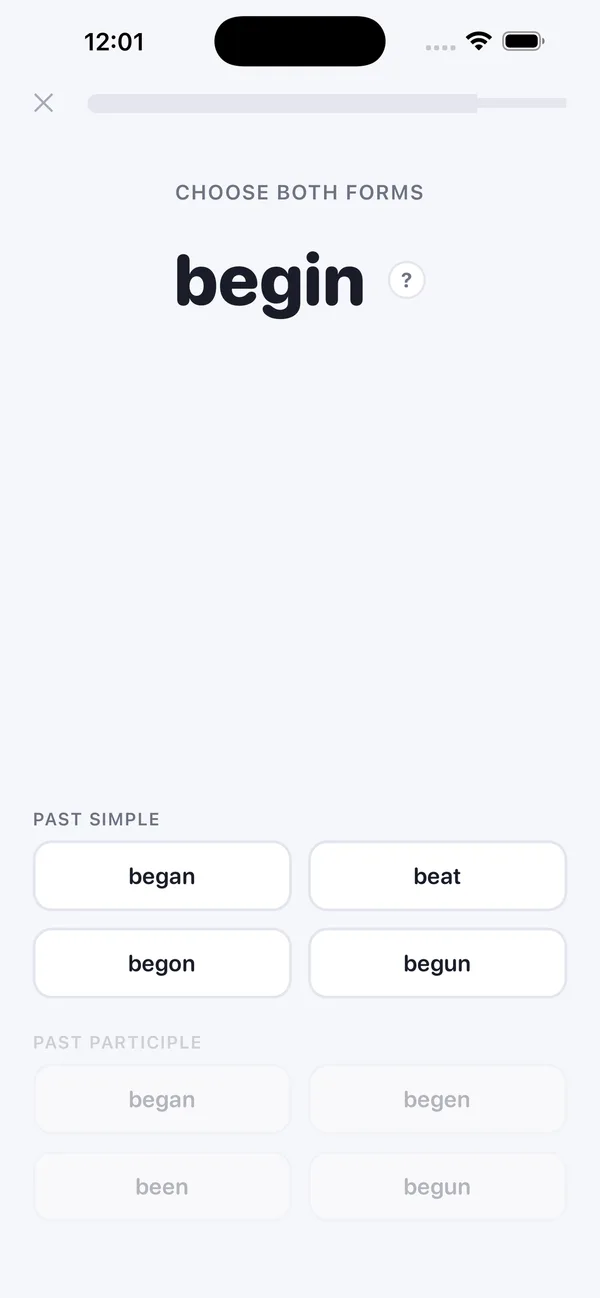
Spaced repetition brings each verb back right before you would forget it. Three difficulty modes, a 60-second Blitz, streaks and a verb collection. Free, works offline, no account.