Home → Past simple vs present perfect
Past simple vs present perfect
One question decides it every time: can you say when it happened? If yes, past simple. If no, or if the point is the result rather than the moment, present perfect.
The decision, in a table
| Past simple | Present perfect | |
|---|---|---|
| Time is… | finished and known | unfinished, or not mentioned |
| Verb form | second form — went | have/has + third form — have gone |
| Goes with | yesterday, last week, in 2019, ago | today, this week, ever, never, already, yet, since, for |
| Question asked | when did it happen? | what is the situation now? |
| Example | I broke my arm in March. | I have broken my arm. |
| What it implies | a fact about the past | it still matters — the arm is in plaster |
The test that never fails
Put yesterday into the sentence. If it fits, the sentence has to be past simple, because the present perfect refuses finished time expressions outright.
- ✓ I saw that film yesterday.
- ✗ I have seen that film yesterday.
- ✓ I have seen that film.
This is also the difference speakers of most European languages have to unlearn, because their own perfect tense happily takes yesterday. English does not.
Where the irregular verbs bite
For a regular verb the choice costs you nothing — both tenses use the same -ed word. It is the irregular verbs where picking the wrong tense also means picking the wrong word, and I have went is the result.
| Base | Past simple | Present perfect |
|---|---|---|
| be | I was | I have been |
| do | I did | I have done |
| go | I went | I have gone |
| know | I knew | I have known |
| take | I took | I have taken |
| see | I saw | I have seen |
| come | I came | I have come |
| give | I gave | I have given |
| become | I became | I have become |
| begin | I began | I have begun |
| write | I wrote | I have written |
| run | I ran | I have run |
These twelve are the ones worth over-learning: every one of them has a different second and third form, so the tense and the word have to be chosen together. More on the third form →
When neither rule helps
Two cases genuinely allow both, and no amount of rule-following resolves them.
- Recent news. British English prefers I have just eaten; American English is happy with I just ate. Both are correct in their own variety.
- A life still in progress. Shakespeare wrote 37 plays — he is dead, the list is closed. She has written three novels — she may write more.
Practise the forms this needs
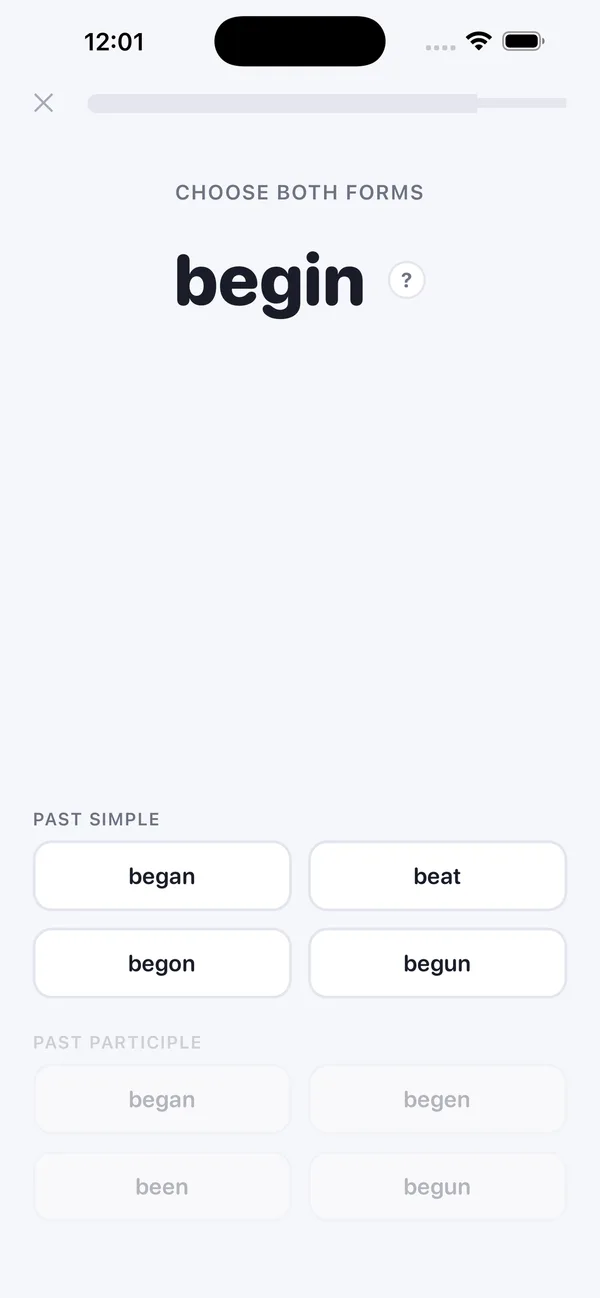
Practise all 175 verbs on your phone
Spaced repetition brings each verb back right before you would forget it. Three difficulty modes, a 60-second Blitz, streaks and a verb collection. Free, works offline, no account.